The Vital Aging Network asked people to tell us about their experiences as Operation Metro Surge spread across Minnesota. Older adults are patrolling schools, supporting vulnerable families, accompanying people to immigration court, donating their time and dollars, and sometimes being on the front lines to protect their family members and neighbors.
Read their stories, presented as they were shared with us. As some of the information is sensitive, we have used only their initials to credit the stories. The views expressed are solely those of the individual author and do not reflect the official position of the Vital Aging Network.
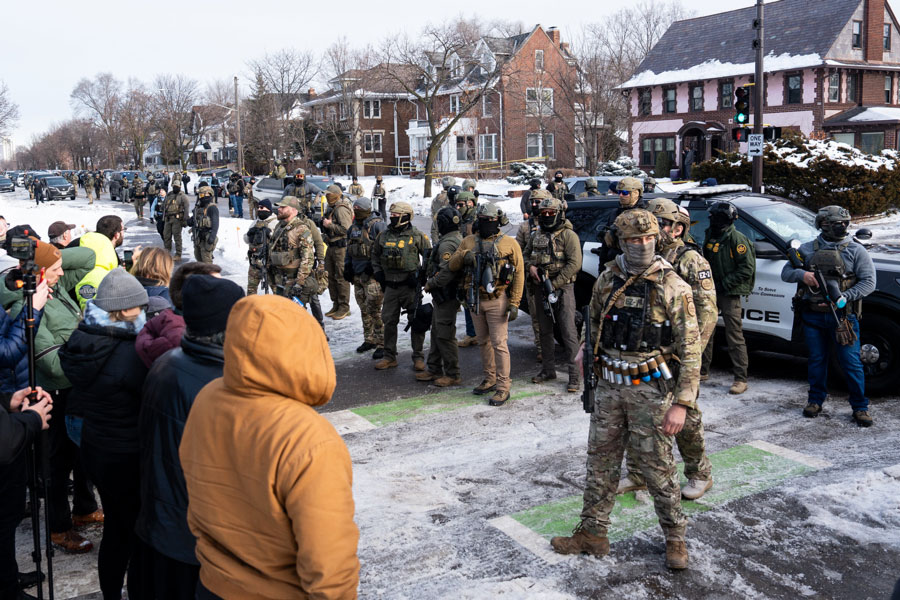
The fear in our community is visceral; I needed to act
I have been active and engaged in many ways over the course of my life. My formative years were in the 1960s and 70s when activism was abundant. The Civil Rights, Women’s Rights, Gay Rights, anti-Vietnam War, American Indian Movement and the Chicano Movement were all vibrant and thriving. Those times shaped my view that collectively we can make a difference to improve our world. So, this year when I felt that threats to our democracy were gaining ground, I decided I had to do something. I couldn’t just sit around worrying and complaining. While ranting about it felt good, it didn’t feel like it was enough. I had to figure out ways to act. As immigration surges were growing around the country, I decided I could wait no longer. It was time.
I have many friends, young and old, from various backgrounds including Hmong, Karen, Cambodian, Mexican, Somali, Liberian, Haitian, and African American. My life has been enriched by knowing them, by learning about the strengths of their cultures, by deepening my understanding of differential treatment and disparities based on race and culture, and by elevating the importance of relationships and community. As Operation Metro Surge engulfed us, I heard their fear, pain, and anger at the mistreatment aimed at them solely because of their color, heritage and identity. My heart ached for them. I felt on edge all the time. Some of them were worried about their children or family members, some were always carrying passports with them just in case, others made sure someone always knew where they were.
One of my very close friends, a U.S. citizen who came here as a refugee at the age of four and has been doing good work in our city for many years, was afraid to leave her home. She asked if we could share phone locations so I could track her when she left to be sure she got home safely and to be there for her if she didn’t. I felt her fear. I was afraid for her and her family. A high school youth I know sent an urgent message saying ICE was going door to door in their neighborhood in St. Paul asking if there were any Asians living in the house or if they knew where on the street they lived. My granddaughter has a friend whose mother left home and went into hiding. Her friend misses her mom, a lot. Other friends of mine have had their cars stopped by ICE and some I know have family members who have been detained. The fear in our community is not abstract or something I read about, it is visceral and sits in my churning stomach.
I felt I had to do something. I attended an Upstander Training in early January, which was attended by 1,000 people. It provided me with important information about people’s rights, what we as observers can and cannot do, and it connected me with a Signal group in my neighborhood. More importantly it provided inspiration. Shortly after the training I went out with a friend to be an observer. We stayed near a Mexican grocery store. While we didn’t see ICE agents, we had shoppers come by to thank us for supporting them and their community. The store owner sent out taquitos and Jarritos to thank us for being there. Their appreciation helped me know that what we were doing mattered.
I expanded my involvement through my neighborhood where I signed up for the school patrol team. We stand at strategic locations around school buildings or at bus stops at drop off and pick-up times to provide support for parents and children. The honks, shouts of thank you, and high fives let us know that being supportive, caring neighbors matters. My favorite part about the patrol was finding out that the fifth graders at the school serve as crossing guards, but because of the ICE invasion the school was going to stop their patrol. The fifth graders were sad because they felt that serving as safety patrol was an honor and they felt valued to be helping other students. Because we adults chose to participate in our patrols the school decided the students would be safe and could continue their roles. I love that I could be a part of allowing those children to feel their agency, to realize that they can contribute to the lives of others makes it all worthwhile.
— S.B.
The ICE effect
The ICE assault has created unimaginable chaos in our once peaceful and diverse neighborhood. Who would ever have thought we would experience a hostile, military-style invasion from our own government? It brings back disturbing images of the Gestapo terrorizing and purging populations during WWII. My husband and I, who are in our 70s, live in south Minneapolis, and have witnessed two unnerving events that frightened us to our core.
Our Latino neighbor’s house was unlawfully raided and ransacked by a swarm of ICE agents without a warrant, looking for drugs that did not exist. Then, the following week, two local women (with Native American license plates) were brutally accosted by ICE agents right in front of us. Their car window was shattered, and they were pulled from their car, thrown to the ground, handcuffed, and abducted without due process. All were citizens, offered no resistance, and had committed no crimes.
We joined a meeting with other neighbors, also upset by the events, to discuss what was happening and what actions we could take. I reached out to the forty-year-old next door who clued us in to the encrypted network — Signal — that other younger folks around us had been using. Through that vital connection we received alerts to active ICE raids, links to volunteers supporting vulnerable families, and notifications of upcoming rallies to bring together our community now under attack.
While some neighbors are choosing to be on the front lines observing and recording, others are opting instead to play roles behind the scenes. People have donated food and money to food shelves, contributed to legal aid funds, made calls to political representatives, and provided stories and videos to the media to show what is truly happening on the ground.
We hope we are not witnessing the unraveling of democracy. While the ICE siege has not yet subsided in other areas, it is heartening to see all the ways a community can pull together in times of need. As John Lewis once stated, freedom is not a passive state but an active endeavor. It’s up to us to recognize when freedom is at risk, and act, as individuals and communities, to preserve those rights so thoughtfully granted to us within the Constitution.
— M.R.
Ride to Immigration Court
Soon after the start of Operation Metro Surge, a friend who owns a cleaning service told me that because she and her staff are Mexican immigrants, they had decided to temporarily stop working. They feared that they could be apprehended by ICE while driving to and from their cleaning jobs. I asked if there were any ways that I could provide help for my friend, her workers, her family, etc. I was in touch with her several times and each time she declined my offers to help with rides, groceries, etc. And then one Monday evening she sent a text and told me that Maria T. (not her real name), the sister of one of her staff, had an appointment in Immigration Court at the Whipple Building the following day. She wondered if I could provide a ride for Maria. I had never met Maria and had no information about her situation.
I agreed, knowing that the Whipple Building has become a frightening symbol of all that has gone wrong with the ICE occupation in Minnesota. I wasn’t sure if it would be possible to drive into the parking lot, if I would be able to accompany Maria into the building, or worst-case scenario, if she could be detained, depending on her immigration status and what happened in the hearing.
My husband and I picked her up and did our best, despite language challenges, to help her feel comfortable and safe with us. Maria told us a little about herself and her immigration story. She said she did not understand the reason for the court hearing, and she did not have an attorney. It was a frightening situation from my perspective, and I could not imagine how frightening it would feel for her.
Much to our surprise, we were allowed to enter the Whipple Building parking lot (although the guard neglected to mention it was full of ICE vehicles and ICE agents and there were no spots available). After finding a parking spot in another lot, walking through imposing fences and loud protesters, we entered the building. Again, to our surprise we were all allowed to enter the building, enter the court waiting room and eventually enter the courtroom with Maria.
There were about ten immigrant hearings scheduled in the courtroom that afternoon. We listened as eight other cases came before the judge — individuals, mothers with infants, families with several children. Maria was clearly nervous and cried as she listened to some of the stories. Finally, Maria was called to the table in front of the judge. It was soon clear that she had not complied with the judge’s previous request that she file an asylum application. We did not know why this had occurred, but we knew there were many possible reasons. We feared that the result could be detention or even an order for deportation. After some additional questioning, the judge told Maria that she would have two additional months to file her application and if she did not do that, the judge would recommend deportation at the next hearing. We were all very relieved and Maria gave us big hugs as we left the courtroom.
We took her home and she now faced the daunting task of finding an affordable attorney to help with her asylum application. We offered her information about pro bono immigration attorneys. In our last communication she had contacted an attorney who would work with her.
— G.G.
Action has never been more critical
I’m 68, and I’ve been politically active for most of my life. I have never felt that our democracy was more under threat than now. My neighborhood was immediately affected when the ICE invasion began, but when an ICE agent slammed his elbow through the window of my niece’s car, it got personal. With my niece driving and my sister in the passenger seat, two ICE vehicles cornered them, and an agent came to the passenger door insisting my sister open it. When she repeatedly refused, he smashed the window and reached in, trying to unlock the door! My niece saw an opening and pulled away. Their license was identified and ICE started following them.
This series of events has made this occupation visceral and almost overwhelming at times. We knew what to do, we were trained, we had whistles, were on Signal, we were on patrol and on mutual aid. None of that prevented this gross abuse of power. We can’t know what might have happened, but Renee Macklin Good and Alex Pretti serve as the grossest examples of how ICE has dealt with our resistance.
We continue to provide mutual aid, being careful not to be alone in a car, on hyper alert, new locks on doors and safety precautions on our phones. We felt safe enough to join in a bridge protest (disguised) and felt truly joyful to be able to do so. My niece and sister have become very active in local, state and national politics, and I beg every one of you to get active! If you don’t want to campaign, can’t afford to donate, then become an election judge! This has never been more critical.
— S.F.